 |
Preening lorikeets Panasonic Lumix FZ300 |
My favourite style of camera has for many years been the fixed zoom lens bridge type.
Bridge cameras hint at
the possibility of being all things to all people. Of course they fall
short of this ideal in various ways but some are better than others.
Some are even worth buying and using on a regular basis.
Compact and bridge cameras have been neglected in recent
years as manufacturers scramble for dominance in the full frame mirrorless high
spec, high performance category.
But there are still several bridge cams available new and
their prices are holding up well which suggests that there are enough buyers
for this camera type to keep the genre going.
The better bridge cams offer a lot of capability and
versatility for their size and cost. In
particular they have a superzoom lens the like of which you will not find on
even the best smartphone cams, the user
never has to change lenses and the pictures can be very nice indeed.
Here is a list of bridge cams for sale in Australia at the
end of 2021 with prices in Australian dollars with GST included as listed from
the same retailer for comparison, starting with the most expensive. I have only included those with a built in
EVF above the optical axis and a proper handle. I have at various times over
the years bought, owned and used at least one copy of each of these cameras
except the Nikon P1000.
* Sony RX10.4. (2017)
$1789 25x zoom range. This is the best specified of the bridge cams
with the best image quality, capability and performance. I used one for several
years and made many photos with it. If
you want the best bridge cam this is it.
It’s a big thing though and I was never altogether happy
with the user experience or the ergonomics. If I want big I have the option to
use a full frame camera with a selection of lenses.
* Nikon P1000 (2018)
$1499 125x zoom range !!! This thing is huge and the lens a wonder to
behold. I never bought one as I realised long ago that using any camera with a
lens over around 800mm (full frame equivalent) can be very difficult and
consistently decent results difficult to achieve.
* Nikon P950 (P900 2015, P950 2020) $1399 83x zoom range. I had the P900 which was
crippled by only offering JPG capture. The P950 allows Raw capture and has some
other upgrades. I found this camera slow and unwieldy with barely acceptable
image quality particularly at the long end of the zoom.
* Panasonic FZ2500 (2016)
$1399 20x zoom range. This camera
is optimised for video capture but the lens is a bit soft for best
quality still photos.
* Panasonic FZ1000.2
(FZ1000 2014, FZ1000.2 2019) $1199 16x zoom range. When first released this was my pick as the
best bridge cam available with a nice balance of price, features and
capability. The Mk 2 is a mild upgrade and still a very nice all round camera
which is a pleasure to use.
Red dot fanciers can buy a Leica branded version called
V-Lux 5 which is exactly the same inside although it costs considerably more.
* Canon SX70 HS (2018) $759
65x zoom range. Many
contributors to Canon user forums reckon the older SX50 is a better camera. I am
not much impressed by the SX70. The specs might look impressive on paper but in
use the camera delivers at best mediocre image quality, poor performance and it
has a mediocre lens.
* Panasonic FZ300
(2015) $669 25x zoom range. This is the only camera in this group to
feature a constant aperture (f2.8) lens right across the zoom range. I will come back to the FZ300 which has
become my favourite bridge cam.
* Panasonic FZ80 (2017)
$439
60x zoom range. This is an incredibly low priced camera with a big zoom
lens. Unfortunately the image quality,
performance, stabiliser, focussing and overall capability are at a low level so
in my view whatever it costs is money not well spent.
Having spent most of the last two years exploring the
capabilities of the Canon full frame RF system I had an urge to re-visit the
simpler world of bridge camera photography.
Of the eight models listed above I rate only three as worth
buying: Sony RX10.4, Panasonic Lumix FZ300 and Panasonic Lumix FZ1000.2.
My camera of choice for this return to the bridge cam genre is the
Panasonic Lumix DMC-FZ300, a perennial favourite with bridge cam users.
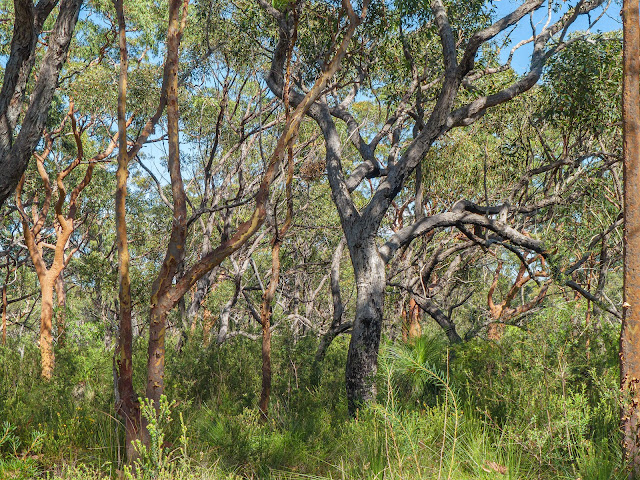 |
Considering the tiny 6.17 x 4.55mm sensor the FZ300 does a surprisingly good job with complex scenes like this one |
The RX10.4 and FZ1000.2 are on most objective metrics better cameras so why have I chosen the FZ300 ?
It goes like this: If the image quality of the FZ300 is good
enough for my purposes and it mostly is then it matters not that another model might
have better technical image quality. The buying decision shifts to other things
like versatility, price, size/mass, ergonomics and the overall user experience. This includes
the issue of likeability which cannot be described in numerical terms and is
therefore often neglected by camera reviewers but is nevertheless very
important.
The FZ300 is the most compact model in this group of eight.
Together with a spare battery, microfiber cloth, two spare memory cards and a
52mm two element close-up filter, the camera with lens hood reversed fits
nicely in a Think Tank mirrorless mover 10 carry bag.
It is the second least expensive of the group yet comes with
a separate charger and power cord for the battery, a reversible lens hood,
fully articulated touch screen monitor of good quality, a nice clear, sharp EVF
with a big eyecup, comprehensive
specification and set of user friendly controls and it can make good quality
auto panorama photos in camera.
It is also listed by Panasonic as having “splash/dustproof
construction with sealings on every joint, dial and button”.
 |
| Hakea Lumix FZ300 The camera is very suitable for flowers and large insects without the need for any accessory close-up attachments. Close -up image quality at f5.6 (equivalent to a full frame aperture of about f32) is rather nice. |
The lens is unique in the entire camera world in having a constant f2.8 aperture across the focal length range from 4.5-108mm (equivalent to full frame 25-600mm). This is labelled Leica DC vario-elmarit which is Leica-speak for an f2.8 zoom lens.
I believe the label reflects some input from Leica at the
design stage although the lens is made by Panasonic. It has a quite advanced
construction with 14 elements in 11 groups with 5 aspheric elements, 9 aspheric
surfaces, 3 ED elements and nano surface coating.
It also features an optical stabiliser which Panasonic
describes as being of “Five axis hybrid”
type. My experience is that it works consistently well.
The FZ300 has many advanced video functions including good
quality 4K video, 4K photo which is based on the video capability and many
options for user control of video recording.
The FZ200/300 system also offers a range of dedicated
accessories including a tele-conversion module, a close-up module and matched
adapters.
In short the FZ300 is a proper camera with an unusually high
level of specification, versatility and capability for its price and market
position.
The FZ300 is an evolution of the popular FZ200 which
appeared in Panasonic’s catalogue from 2012 to 2015. The listed specifications
for the lens and sensor of the FZ300 are the same as those for the FZ200.
My own experience is that each of the several copies of the
FZ300 which I have owned does everything
including image quality and performance better
than my copy of the FZ200 which I found a bit underwhelming. I have also found
that my third and fourth copies of the FZ300 delivered better image quality
across the focal length range than my first and second copies.
So Panasonic is making progressively better use of the same
sensor and lens. Compared to the FZ200 there
is a more capable processor, a firmware update and a different body with a
better touch screen monitor, an upgraded EVF and upgrades to the stabiliser,
autofocus and video.
I have to suspect there has also been improved quality
control at all stages of the manufacturing process. The lens in particular requires
optical elements of extremely high precision to be assembled with microscopic
accuracy then move inside the lens barrel while zooming and focussing within
extremely small tolerances.
After a week with my latest copy of the FZ300 (I think it is
number 4) I have been agreeably surprised by the overall competence of this
little bridge cam. I will be reporting further about my experiences using it.
Interesting!
ReplyDelete